Tuesday, May 3, 2011

26 april-urban solace

Our first day back at work! No one from the Grants Team was at work today, and the office was eerily quiet, very lonely! I read online though, that every Tuesday there was a slam poetry reading at a cafe called Urban Solace in Ulsoor, Bangalore. I suggested it to Joanna, and we made plans to attend.

After work, the guard outside of the office usually helps me to find an auto, directing the driver for me. If they stop across the street he'll shout "Jayanagar, Jayanagar". It is very helpful and he is a sweet elderly man who always smiles in a very friendly manner when I come in the morning and leave in the evening. But today, I stopped him- I needed to go to Kanteerava Stadium instead, to meet Joanna at the climbing wall so we could go to the poetry slam together.

Kanteerava Stadium was huge, with so many different activities going on that it took me a while to orient myself and find the climbing wall. I had come in a dress from office and could see no place to change, so instead I watched Jo and some other climbers play around on the wall for about an hour. Then, Jo and I left the stadium to hail an auto. This proved exceedingly difficult, but we finally found one and reached Urban Solace with no difficulty. The restaurant is charming, with a decidedly cafe feel, bookstores all around and a very Western menu that made me skeptical. We picked a table near the back and observed the crowd, an interesting bunch of faces...quite a few fedoras, casual cigarettes and glasses of wine if you catch my drift.

I ordered a pesto pasta and it was superb, as was our chocolate cake dessert! The woman who was speaking was a graphic designer from Bangalore, slamming poems for the first time in public. She was smart, but nervous and long-winded so it was hard to stay focused. At the table next to us was a young girl and a young man again with a fedora and spectacles. He looked enthralled by the reading, slapping his knees, snapping, calling out in admiration and clapping loudly enough to put less enthusiastic audience members to shame. He kept turning around to our table and asking if I would read, and offered to buy me a glass of wine if I did. I politely declined and told him he should read, which he did, and well.

His name was Dominic or Dominique...pronounced like the latter in any case. He was the most confident and controversial of the poets, fearlessly dropping in sexual imagery and with a delivery that sounded most like slam poets I've heard in the past. An American girl who looked a little younger than us and who was there with her other American friend read a slam poem she had written about her mum, and then one elder man read from a book he had published.

After the whole thing was over, the young girl sitting with Dominic (named Smitha) came over and sat at our table. She said her brother was in graduate school at Dartmouth and that she was heading to the University of Wisconsin in June to pursue graduate studies herself. A graduate of Bangalore Medical College, she knew Dominic from school, where he was 5 years her senior. Dominic himself eventually came and sat with us. He explained that he was working with the IPL cricket league (performing some sort of managerial functions which he hated) to make money, and that he was trying to get to know India. He told us he had no desire to travel until he knew India, which he said would take him at least 7 years.

A while passed in good conversation, and then their friend arrived, a man named Ravindra, part of a Bangalore theatre group called Rafiki. We talked with them about the youthful side in Bangalore, the drug scene, safety for women and more until finally, around 10:30, the cab I had called arrived for us. Before leaving we were given "personal affirmation cards", which we picked from a large bowl. They are these coloured cards the size and shape of business cards that say things like "no matter what challenges come your way, always remember you are loved". Outside the restaurant, Dominique gave me a string of jasmine flowers. We graciously took our leave, overwhelmed with the interesting night...The driver was Avinash, a friend of a woman I know from work who is very reliable and he safely took us home.

25 april-crepes fail

We tried the crepes place again in the morning but were informed that they didn't open until 11:30! There would be no crepes for Joanna and I in Goa, it seemed.

Instead, we ate at the Indian restaurant on the corner, which turned out to be very good. Jo had a cheese masala dosa, and the cheese made her very happy. I had a masala dosa, which was also quite good, and buttermilk to top it all off. The drive to the airport afterwards was smooth, but saying goodbye to Dadi was very sad! We promised to visit again soon.


We got to the airport with plenty of time to spare, but encountered a number of small delays. First, we were too early to put our baggage through screening. Then, they decided Spice Jet should enter security before Kingfisher passengers. So we waited and read, glad we had brought entertainment! A foreign woman impatiently waiting with her family made a rather odd comment to me. She said "no matter how long I'm here I never get used to it" and didn't offer any clarification.

Once inside security, we found we couldn't get to any of the shops and restaurants! But the flight was nice and although the drive back was long, we enjoyed being back in Bangalore. Boy, is the return to city traffic something.

24 april- spices, bom jesus, new bags

Happy Easter! In the morning, Joanna and I lazily awoke and decided to go get crepes at a crepes-and-chocolate place we has passed earlier. I was so excited but when we got there the restaurant was closed (likely for Easter). The shop next to the crepes restaurant was a small bookstore with a wide selection of foreign books, likely donated by tourists passing through. As I was contentedly browsing the shelves, an Englishwoman came into the store, very flustered. She spoke to the saleswoman urgently, asking for another woman who wasn't in the store. She wanted to speak to her about a sick dog she had seen at the beach. She tried earnestly to describe it, matted, blond, and it seemed to me that the saleswoman couldn't care less about some stray dog. But this Englishwoman went on and on, very earnestly begging for someone to come look at the dog. She called to her husband, who brought in pictures documenting the animal's plight, and these were handed to the saleswoman with a plea to please, please inform the other woman that she should go look after the dog (maybe she was a vet?).

Giving up on crepes, we went instead to a place a little further down the road called Leda Lounge. It had a nice, open feel with zebra-upholstered furniture and trendy music. Off season though, so no-one was there but us. The two bored waiters handed us a very simple breakfast menu- eggs, toast, bacon, sausage. While eating, we looked up at the TV and saw on BBC a man speaking with a Dartmouth background behind him! So we took a picture of Dartmouth here with us in Bangalore, and then headed out into the heat.


On the way back towards the hotel, we stopped at a roadside tourist stand to buy some Indian-looking fabrics. Both of us made satisfying purchases, and then we were picked up by the van with Nani and Dadi and Dada Desai. Off to the spice farm!

After driving some distance, we stopped the car at a cricket stadium and waited for Rohit Anand's car so we could follow him the rest of the way. He arrived and led us another distance, until again we waited for a car with his friends to lead the parade we formed all the way down windy roads (I am missing the platitude of Houston highways) to a spice farm called Pascoal Organic Spice Village, located in Ponda, Goa.

We walked into what looked like a rainforest, and the first thing we saw was a cage filled with emus.


Further on, we saw a sign that advertised elephant rides and behind it, an elephant held by a very short chain to a tree. It looked miserable, lifting its hind leg repeatedly to try, unsuccessfully, to take a step. Later, when we asked one of the spice village employees about it, they said the elephant was a male and thus dangerous. I don't feel like this justified anything- there was no need to keep an elephant at all!

From the parking lot, we walked through this rainforest path and then down some stairs towards an area where we heard loud singing. When we emerged into the open, we saw a circle of women dancing around some central object, clapping their hands rhythmically and singing something sort of tuneless that we were told was the 'welcome song'.


We had petals thrown in our hair, and we were garlanded with flowers and tikka-ed (where a red powder is dotted on your forehead). I didn't like this and I can't quite place why. It just seemed so forced and commercial. And it was all totally unnecessary.

Anyways after gawking at the welcome song women, we were lead to a shaded dining area where we were all served a welcome drink, a lemongrass tea with mild spices for additional flavour.


It was refreshing, and according to a placard we were given, a great cure for migraines. This placard was part of a booklet put together of natural cures derived from the spices available on the farm. The curable afflictions ranged from headaches to bad skin, bad hair, an inability to 'perform'...

Rohit Anand and Anju


were at the spice farm to play cards with their friends. They told us that every Sunday they went to play cards and sometimes chose an interesting location so they could simultaneously get in a bit of exploration. Their friends headed off to find a 'cottage' to settle down for cards, but a few, including Rohit Anand and Anju joined Nani, Joanna and I to take a spice tour. Dadi went to rest at the cottage.

The tour guide was a woman with a voice that was slightly too loud.


She would constantly reprimand members of the group who lost attention, commanding "listen, look, pay attention" in a sort of middle-school teacher way. We saw black pepper, betel nuts, curry leaves and many other spices common to Indian kitchens including a miniscule red pepper supposed to be the hottest in the world. Nani loved the tour,  and often offered her own home remedies in addition to those the tour guide explained.

We watched a man demonstrate how betel nut palms were once climbed.


He wore a cloth around his ankles and scaled the first palm kind of like that scene in Mulan...and then at the top would swing to others, back and forth with grace and minimal effort. At another point in the tour, we saw cigarettes made from banana leaf paper and natural tobacco.


There was a huge clay stove-like structure that I initially thought might be a tandoori oven.


It turned out to be a distillation machine for making liquor out of cashew nut juices (the ones that come from the fruit Jo tried on the island while paddle-boating). We were later given small shots of this liquor and I had a sip without knowing what it was...it was like fire. So nastily strong!

After the tour, we headed back to the central area. A ladle of freezing water was poured down everyone's back from an earthen pot (they hold temperature constant pretty well) and it was very refreshing! We browsed the spices that were for sale, swung in some hammocks briefly, and then all settled down at the cottage and while Rohit Anand and Anju played cards with their friends and drank, Jo and I settled down to Rummy 5000 (our extended version of Rummy 500). It was pleasant, but I would get so bored spending my Sundays like that, cards every week, the same old routine and all conversation centered around the game...

Anyways, after ages of playing cards we were finally summoned to go eat. The food was laid out in a line of earthen pots and it looked good,  but all dishes were seafood or meat in Goan style. So, Nani and I had our cabbage and rice. We were very kindly brought a pot of dahl, and it was delicious! Anju asked if Joanna and I would want to go paddle-boating, but at the spice farm it cost 300 Rs a person, and was just not worth it.

Dada Desai, our driver, was pacing back and forth on a gravel stretch with his eyes on the ground and Nani asked him what was up. He confessed that he had lost the keys to the van, and a mild panic broke loose. He said he remembered taking the keys from the car, and was sure he had lost them while pulling his handkerchief out of his pocket (he had lost the kerchief as well). A plethora of suggestions were thrown out, increasingly complex. One was that we drive back to the hotel with Rohit Anand, find a locksmith, get the driver to come back with the locksmith, have him make a key, and then we would fly out while the driver would take a bus back...etc etc etc. It all became very confusing.

The driver and Rohit Anand set out to do the spice tour once more and hopefully find the keys on the path. Others headed back to the cottage to continue playing cards and wait...I went to the parking lot because no one had actually checked the car yet.

There were the keys, still in the ignition inside the locked car. I went to the information window at the end of the parking lot and asked the group of men inside if they could help me open the car. At first they refused, thinking I had come in an expensive taxi, but when I told them it was an Omni, they thought they might be able to help. So, the whole group followed me to the car and started to push against one of the windows, hoping the lock would be weak and give way. After a lot of pushing, they managed to force the window open and we opened the door and grabbed the keys. Unfortunately this broke the window and we suffered through less fresh air on the drive home as a result. But let's call that a lesser of two evils.

So, we brought the keys back. Everyone with the exception of Nani, Joanna, Dadi and I started admonishing the driver behind his back. In fact, they had been admonishing him throughout the ordeal. How stupid could he be, how irresponsible, make him suffer, it's his fault he should deal with it, and on and on. I couldn't believe it! Yes, it was a minor annoyance, but everything worked out so quickly that there was nothing to stress about. And everyone loses their keys. Honestly.

After the spice farm, we headed to Old Goa to see the Basilica of Bom Jesus.


It is a World Heritage Site famous for holding the remains of St. Francis Xavier, and was consecrated in 1605. The place was pretty populated by tourists, and opposes another big church in Goa, the Se Cathedral, also built by the Portuguese during their occupation of Goa. Inside the cathedral, it was very crowded and looking towards the main altar, we could see that a wedding was taking place!


It seemed like such an unfortunate setting for a wedding, with so many tourists crowding up, but I guess to each his own. We walked through adjacent rooms, looking at artwork and finally stopping before St. Francis Xavier's remains in a thoroughly majestic tomb. Nani and I donated money, specifying on the donation form that it should go to the poor. I did this mainly because I found the detailed donation form very interesting. You had so much 'choice' about where your money was headed! 

Se Cathedral was quieter than the Basilica, so I liked it more. It was pristine and not cluttered with tacky decor the way the church in Mysore had been. We walked around for a while, and then headed back out to the van. On the way, a young boy tried to sell me candles, these ultra thin white wax ones that every peddler outside the churches seemed to be selling. Most of the vendors were so obnoxious and it frustrated me to see that outside a religious building. To this boy, I gave money but didn't take a candle. I don't know why, I didn't even think about it, I just didn't want a candle and I wanted to give him something. But it seemed kind of inappropriate afterward and I couldn't decide how I felt about it.

We asked the driver to take us to Panjim, a city in North Goa famed for casinos and boat tours, 30 km away. Instead, he took us 30 km in the other direction, back towards the hotel! When Nani realized this, she asked him why and he said there was nothing to see in Panjim. Probably a decision he should have consulted us about...

So we stopped in a South Indian restaurant to eat. We opted for the A/C room, which was very weird. It was shut in, with blasting A/C and bad lighting, two long tables as the only furniture. It reminded me of one of those side rooms at Discovery Zone where kids eat cake. If that makes sense. The food was absolutely horrible. Watery chutney, oily tasteless sambar, undercooked idli. Literally inedible!

Our last stop before home was to go buy some bags. We discovered that with Dadi's gifts and our souvenir purchases in Savantwadi and Goa, we had too much luggage. We stopped in at one of the tourist shops, and started haggling for bags. The guy in the shop wouldn't haggle as low as we wanted, explaining that then he would make no profit off of his wholesale price. I always sympathize with that argument, although I have no way of knowing if he's telling the truth. I had a nice little talk with him about where he was from and how business was, and we ended up buying two great bags, all rough and colourful. Mine is definitely one I hope to use for a long time.

Finally, we headed back to Sea Mist where we read, watched TV and tucked in for our last night in Goa.

Saturday, April 30, 2011

23 april- goa.

Back in the bumpy awful sickening stomach-lurching oven-like car. This time at least, the ride to Goa seemed shorter. We were being driven by Dada Desai, a driver our family has used before in Konkan/Goa, and Sunil stayed behind this time. I asked to stop again for more salted watermelon (mmm) and then settled down to nap the sickness away, dreaming of Dramamine. The entry into Goa is stark. All of a sudden there comes this stretch of road where billboard after billboard assaults the eye with large English print on all sides. Are you in India?

You're in Goa, which is pushing it. Goa is the smallest state in India, the richest, and a haven for beach-loving alcohol-drinking club-hopping tourists from around the world. Unfortunately, this is also the season for blistering heat and thus off-season in Goa. From October through February beaches are crowded and parties are wild but in April, things were a little quiet.

Goa used to be a Portuguese colony, and the Western influence is evident in architecture and city design. Apart from the gorgeous white churches, streets are sometimes brick-laid, and buildings are decidedly European-looking, not to mention all signs are in English. We found our way to Colwa Beach, the biggest beach in Goa, and stopped to get directions. Where were we headed?

Well, my mum's school friend Rohit Anand owns a resort in Goa, and he had invited us to stay there for a discounted rate. Rohit Anand's directions included a lot of "and then you can just ask anyone and they'll point you further' so it was a very interactive ride to the hotel as we kept asking passersby for further directions. I was not sure what to expect about this hotel, but when we arrived I was blown away.


It is the Sea Mist Resort in Colwa, Goa if you're ever looking for a fantastic vacation experience. The moment we arrived we were greeted by Rohit Anand and his wife Anju. They were exuberant and very hospitable, immediately inviting us in for cool drinks and to come choose our rooms. Save one more room, we were the only customers of the resort because it was off-season, so we had our pick of residence. And residence it was. Instead of single or double bedrooms, each room was a complete apartment with kitchen, bedroom, bathroom, living room and terrace/balcony. Apparently most of his clients come for long term stays, from 1 to 3 months. What a dream!

We chatted about my mum's childhood with them, and after biscuits and cool drinks, they told us they were headed to a party at a spice farm the next morning! They invited us to join and we readily accepted.
The locks on the door were a little difficult and Dadi got locked inside hers and Nani's apartment/room, but luckily I managed to figure the door out!

Jo and I went for an evening dip in the pool, heeding a sign that reminded us not to wash our clothes in it. Rohit Anand and Anju had given us some tips for enjoying ourselves in Goa, and we had a wild night planned. We first headed out with Dada Desai to a nearby Indian restaurant to pick up dinner for Dadi. After bringing it back, we headed out again to Johncy's , a popular restaurant located right on the beach. We dined with sand between our toes, waves lapping in front of us. The woman seated at the table next to us was totally alone and looked so utterly content to be there...it's an odd thing to mention or even remember but the emotion was so starkly evident on her face.

One irritating part about the dinner was the amount of vendors that just came up to us while we were eating to peddle useless goods. Things that flashed and glowed and made noises. In Goa, everyone is a tourist (especially at a place like Johncy's) so no one is safe from vendor harassment. We had invited Dada Desai to eat with us, Dadi's request, and he ordered a veg biryani, while Jo and I pondered the menu. I opted for bindi (okra- lady fingers) and roti and dahi (curds), while Jo got her seafood fix with crabs and prawns. The restaurant next to Johncy's was located a very obvious 30 feet forward, meaning they were in fact closer to the seashore. They had a sign out front printed in large letters "you should be here". And they played live music and fireworks.

Luckily, such things are public goods and thus non-excludable and non-rivalrous. Pardon the economics. So we happily enjoyed their music and fireworks from our seat at Johncy's, toes in the sand. After a wonderful dinner, we got back in the van and headed to Margarita's. Margarita's is a young people's dance club that was recommended to us by Rohit Anand and Anju. We entered, and inside passed through four doors before emerging in a room with pounding music, trippy decor, and no inhabitants save some sketchy guys at the bar. So we left again. We browsed some nearby tourist stalls, and after a while, tried Margarita's again. No such luck, perhaps because the next day was Easter Sunday.

So, we ended the night at Colwa Beach, stepping into the water that was as black as the sky ( a very eerie sight ) before returning home. We fell happily asleep in a bed with a thick mattress under ...actual air conditioning. Unreal. 

22 april- paddle boat adventures and island forts

We awoke with even more ant bites. After chai, we all piled into the Omni (Sunil, the actual Driver, Nani, Dadi, Joanna and I) with a massive basket of food prepared by Dadi.

Nani gets just as carsick as I do, so I suggested we stop in a field so we could take a break from the winding roads and bouncing Omni and stretch our legs. Jo and I ran into the field close to the area farmers were plowing with their water buffaloes, and took pictures.

 JO IS SO PRETTY AND HAPPY :)

It felt great to be out in the open air in the rainforest, so far from the pollution of Bangalore. We came across a collection of flattened, drying dung patties used for fuel.


It reminded me of a book I had read about India when I was young called Homeless Bird by Gloria Whelan. It's a beautiful children's book about a young Indian girl forced by her family to marry, and then widowed young.  After observing the dried patties and playing with touch-me-nots, little ferns that close up when you stroke them (so fun!), we piled back in and were on our way.

We stopped next on a bridge to take more photos of rainforest and water expanses.


Finally, we came to a temple by a waterside where we ate delicious soft idli and chutney with plates and forks and napkins. It was the perfect place to eat breakfast, all lazy dogs and hazy air.


Down on the water, Joanna and I spotted an array of paddle boats and canoes and decided we wanted to go for a spin. No other customers were around, perhaps because of the heat, but we went and bought tickets for 25 rupees each (for 30 minutes). The man asked us if we could swim, had us sign a form entirely in Konkani and led us down to the boats. He showed us how to turn and assuring Nani and Dadi we would be safe, we sped off. Okay, more like inched off. Paddle boats are hard to 'speed' in.


We spotted a huge house tucked away in the trees on one side of the river bank and my head swam in envy. What a dwelling! On the other side, we thought we saw the top of a temple far up on the bank and decided we should explore. No one had told us (in any language we could understand) that we couldn't stop the boat anywhere, so we pulled up on a rocky bank and set out to explore. As we got out of the boat, we spotted a lone paddler heading our direction. We were initially worried that it was an employee coming to yell at us, but it turned out to be Sunil, dispatched as makeshift bodyguard in case we couldn't handle the sturdy paddleboats ourselves.

We hiked up to the hidden temple and took two small clay diyas (little lamps that you fill with oil and a cotton wick) as souvenirs. On the way down, Sunil showed us the cashew fruit. The cashew is the only fruit (besides the strawberry) where the seed grows outside the fruit. He explained that the juice from the cashew fruit was drinkable, so Jo tried some. She said it was very sweet with a strange aftertaste.


We headed back to shore and set off again. By the car there was a creek and a bunch of chirping birds in the trees, and Nani and I decided Mummy would love all the little birds if she were here.

Our big stop of the day was Malvan, a small town on the Arabian Sea Coast. Just off the shore is Sindhudurg Fort, built by the Maratha warrior King Shivaji in 1664. It is an imposing structure with an entrance concealed so it can't be spotted from a distance. Today, more than 15 families still reside within the fort although employment is scarce. Before the tide rises during the monsoon season, they have to bring over provisions for four months because it will be impossible for them to return to the mainland.

We bought tickets for 27 rupees, and Jo, Sunil and I elbowed our way through a crowd onto a rickety wooden fishing boat that held 20 people. Jo and I were the only females aboard, and the rest of the passengers were jolly young men singing and joking loudly.


We passed crab covered rocks, and some 10 minutes from the mainland we docked our boat and stepped out onto the sand. Through the winding concealed entranceway, we entered Sindhudurg and immediately climbed a steep set of small stone steps to walk along the wall for the best view.

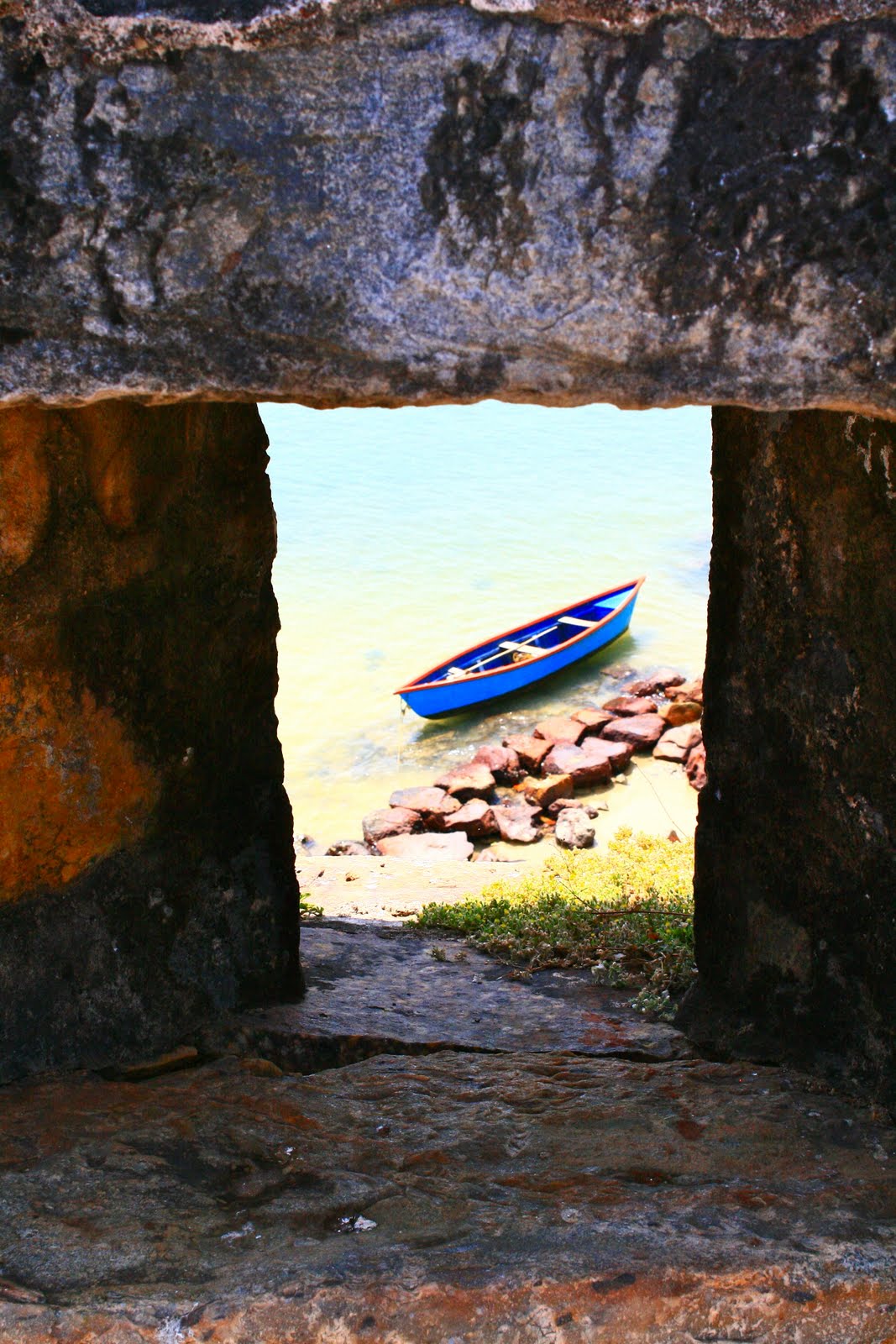
The inside of the fort, looking down, was pretty, with a lush grassy covering and palm trees. I decided it looked like it should be a tiger enclosure, but there were no tigers. Looking out over the walls, the sea looked majestic and sparkling. There were many small windows and holes cut into the walls (some perhaps for weapons others for looking out) and crouched by the windows, you got a fantastically cool sea breeze.


We tried to visit the temple within the fort, but there were too many tourists and we needed to make it back in time for the boat (coming every hour). We waited on the boat for a while as the 'captain' went to round up those jolly men who were late in returning. Then we headed back to the mainland, accompanied once more by songs and jokes. The men tried to take pictures Titanic style, standing up on the helm of the boat with arms spread, and they laughed raucously with each failed attempt.

A brief stop to a beautiful pebbly beach, very secluded and with rocks stretching out to sea...


Back in Malvan, Sunil led us to the car where Nani and Dadi were napping. We found a small place to eat, tucked away in a little alley. We had to remove our shoes before entering a cool, dark room, low tables with plastic stools. We were followed in by a few other families and soon every table was filled. No menus and no ordering, one meal for everyone. There was no bottled water, so I left the restaurant in search of some. I walked down a small street into a nicer restaurant at the end, where I bought two giant bottles of water for only thirty rupees. I could really get used to Konkan prices. When I was leaving the restaurant, I heard drums beating and bells clanging and a noise that sounded like a gunshot. There was a man dressed in traditional clothing dancing around and smacking a long, dangerous-looking whip on the ground in front of people and stores. Everyone looked scared, and handed him money as he went on his way. He literally ran after people with this whip in hand to get money. I was scared and didn't want to encounter him, so I sort of ran back to the restaurant.

We were served roti, dahl and some sabzi (vegetables) that was all totally delicious. Off we were to Savantwadi, a town that is famous for its wooden crafts. The driver dropped us off at one end of the marketplace and we walked through winding streets to the other end, where we entered a small narrow shop selling exclusively wooden crafts. We picked up presents for people back home, rejoiced at the low prices, and finally headed on back to Kankavli.

Near Kankavli (or perhaps within it, I forget) we stopped at a drum shop.


We watched something like 6 men making tablas and dholaks, two types of Indian drums, and inquired about prices. They were expensive and looked hard to pack, so I gave up on my dream of owning a tabla for now. Anyways, I should learn first.

Another stop that we made was at the cashew factory in a town, a place that honestly looked like a sweatshop. Here I think pictures say more than words...


Back at the apartment, Dadi taught us how to make bajra roti. It is a type of bread that is much coarser than the roti/chapati we are used to. It's called 'poor man's food' because it is much cheaper and easier to make. The poor of India traditionally eat bajra with chili peppers and onions, the two cheapest vegetables. Actually, bajra is delicious and its no-fat no-oil composition makes it a healthy option. It is easier to make than roti, because instead of a rolling pin, you can press it out with your hands. Jo and I had a lot of fun playing with the dough and made some pretty impressive bajras, if I do say so myself. We ate them with this delicious chutney Dadi made from the mangos that were about to go bad.

We rounded off the night with a truly terrible flick on television called Sundays at Tiffany's about a woman who marries her imaginary friend from childhood. (Don't worry, he's real now). Someone actually spent money making that movie.


21 april- around the village

Upon rising early, we discovered our bed had attracted quite a few ants, and we were covered in bites. Yikes! Dadi had woken up at 3 AM to prepare more treats for us (quite unnecessarily!!) and breakfast included dhokla. It is possibly my favourite Indian snack, a steamed lentil dish with a sourish state. Dadi learned to make it in a cooking class she took while in Bangalore and she is a stunning cook. Jo wasn't a big fan, but I just gobbled them down.


After breakfast Joanna, Nani and I went out for a walk around Kankavli. The entire ride over, Dadi and Sunil had been telling me how far the village has come. A few years ago Kankavli was secluded from the bigger world. There wasn't much available, but now one can find anything of necessity. It is hovering between 'village' and 'city', and is far more accessible. The village certainly looks much more advanced than the last time I visited, with busier main roads, much more transportation and less traditional clothing (I spotted a girl in jeans!). We still stuck out like sore thumbs though. 

I like Jo's description of the apartment's surroundings, paraphrased: "a mix of houses and apartments, slow-moving construction sites, sparkling clean new buildings that stick out like sore thumbs, and a couple of shacks built of corrugated metal and palm fronds". On one stretch of road there was a field with water buffalos and white birds on our right, and a sort of palm tree farm on our left (for coconuts or betel nuts, I couldn't tell). We saw a lot of these water buffalo/bird pairings, the bird often perched on the buffalo's back, and it always made me think of the idea of symbiosis although I'm not sure these animals get anything from one another. 


We passed the hospital in Kankavli, a brightly coloured very clean and modern looking building. 


Nearby, many buildings seemed under construction or expansion. Up against one of the rickety looking wooden construction structures was an image of what the completed building would look like. It seemed like a pipe dream, but one must not underestimate the secretly competent Indian construction methods. 

Outside of many houses, the stoops were wet and white rangoli designs were drawn with rice powder. 


http://www.activityvillage.co.uk/simple-rangoli.jpg

First thing in the morning, each family will wash the stoop outside of their house and make such a design. It is a pleasing, fresh morning ritual that appeals to me greatly...


Because of the heat, we could not leave the house until 4 pm. Dadi learned that Joanna loves sweets, and made gulab jamun- indian milk balls in rosewater-scented sugar syrup. 

http://southernspicecuisine.com/images/desserts/gulabjamun.jpg

Jo and I played cards for ages. We started Rummy 5000, a super-charged super-long invented spinoff of Rummy 500. Between cards, bananagrams, reading and television we passed the hot midday. At 4, Sunil arrived to take us exploring in his auto rickshaw. He is very proud of his auto, with its light purple top (note the 'S' for Sunil decal on top) and wildly upholstered interior. I asked him why the top was purple, and he informed me the drivers of Kankavli had chosen the colours themselves. Thus the many purple auto tops around. 


We passed a large grassless expanse of land, and Dadi and Sunil told me it served many important purposes for the village. It was sometimes grounds for a large and fancy marriage, and on other occasions served as a heli-pad. For all the helicopters that I imagine would choose to land in Kankavli, of course. 

Our first adventure was climbing endless steps up to a temple on top of a hill. 


Jo and I were panting like anything when we reached the top, but when Nani emerged she hadn't even broken a sweat. The temple was peaceful and the 360 view was incredible. 


We spotted the college from a distance (Kankavli has an engineering college- this is no antiquated village!) 


and a smattering of houses and shops among the lush rainforest foliage. Sunil told me the temple was a place to come when one got bored in Kankavli, and thus a popular chill-out spot for the college students. It didn't seem particularly thrilling to me to come hang out at a temple spot when bored, but who knows. It was quite pretty. 

Heading down, we passed a small building that advertised engineering classes with a sign that said "Best Engineering Classes!!! Really!!!" with yes, that many exclamation marks. We next took the auto to the Engineering College, where we saw the younger side of Kankavli. Kids looked basically just as they did in Bangalore, and they were all speeding off either on foot or bike or scooter to return home as the day had just ended. 

Our next stop was a high school very close to the village. My relatives helped establish the school, and Dadi attended. It looks remarkable, especially given how long it has been around. School was empty for summer vacation, so we peeked into classrooms where I decided I am happy in the United States to have my own desk. I feel so spoiled. 
After one more temple stop by a well, where Sunil taught me to drive his auto...


we drove to a riverbank where we were warned not to go into the water because of the dirtiness and mosquitos. We watched a man take his water buffaloes in for a bath, and admired the natural beauty. 


Joanna and I have been looking for Indian-patterned bedspreads, having admired them both at Nani's place, Dadi's place and Shruthi's house. Sunil took us to a fabric store in Kankavli, but when we asked to see bedspreads the majority were tacky looking Western ones featuring outdated or obscure cartoon characters. Every time we asked to see a more traditional looking bedspread, the salespeople would encourage us to choose the 'better', more 'Western' ones. 

I was so bothered by this. With this whole drive towards modernization and advancement, it's amazing how little pride there often is for the amazing cultural beauty of Indian things. Instead of valuing our own country's work, these small villages aching to make it to the big time are selling cheap-looking Western designs that no one in the US would ever willingly buy. Roadside sellers offer plastic buckets in neon colours, hairclips and large plush pink bears with bead eyes when I would be much more drawn to carvings, wooden items and embroidered cloths. 

Back at home, we spent the night with cards and books and television once more. Sporadically, people would enter the apartment to see me, knowing I was visiting. I felt great that they wanted to see me but they never introduced themselves and I had no idea who I was chatting with. That too, they often spoke to me in Konkani or Marathi and as I don't understand either, conversation was pretty one-sided. 

We watched a violent Quentin Tarantino movie featuring Antonio Banderas called Desperado. Kankavli doesn't have the best selection of English television, but at least there was something. It is funny though, to see the choice of Western shows featured. Saturated with cowboy themes, it is no surprise there are some odd perceptions of life in the West. 

20 april - did i mention i love air conditioning?

It is time to play catch-up in a massive way. I'm about 9 days behind on this blog and what has been keeping me back is the trip to Konkan/Goa. We traveled from 20 april to 25 april, and there was just so much to say upon returning that the thought of posting became totally overwhelming. So, Joanna and I wrote a joint post about our adventures (Joanna writing most of it!). Now that I have some free time, though, there are some additional personal details I want to include so I've changed it a bit for my purposes. I could never have done this without Jo and her stunning memory of the sequence of events, and of funny little details and quotes.

The 20st of April was a Wednesday, and I had taken off work. Our flight to Goa International Airport was sometime around 1:30 but we left closer to 10 AM, being familiar with fickle Bangalore traffic. The airport was indeed, quite far from our flat. At the check-in counter, I handed the woman our boarding passes and passports. She asked me where the other three people in our group were. I assured her we were only three, and she read me off three other names to see if I recognized them. I once again promised her I would know if we were supposed to be traveling in a group of six and luckily she believed me, attributing the slip up to a glitch in the computer booking system for Kingfisher Airlines. We checked in Nani's suitcase, and Jo and I were very pleased at having successfully packed everything needed into only one backpack and one purse each.

The security lines were, as usual, divided into a men's line and a woman's line. I used to always be frustrated that the men's line moved faster, because women are drawn individually behind a screen to be scanned by the handheld metal detector in privacy. This handheld metal detector step is really crucial , because the standing detectors beep every time a woman walks through. Why? Because none of the Indian women take off any of their jewelry going through, and they wear a lot. Gold necklaces, bangles, earrings, noserings, anklets all happily shimmer and they trust that when screened in private, the source of the constant beeping will be confirmed as less criminal and more decorative.

When we got to our gate, we were 30 minutes early so Jo and I set off in search of food. There was a nice looking Indian place just around the corner from the gate, and Jo was all set to order the Chicken Biryani (a dish of chicken and rice). We asked for a sample so she could check the spiciness, and the man behind the counter started dishing out small finger bowl samples of virtually every dish behind the counter. Having feasted on the samples, Jo was already full but feeling bad about not buying anything, ordered a Chicken Biryani parcel (it means 'to go'). I ordered dahl, rice and dahi, too time-pressed to go any more adventurous. The man told me he couldn't parcel that because it would be too runny and it took me a long time to convince them that I would handle the liquid if he would just give me a box so I could make my plane.

Meanwhile, Nani was frantically calling us to return in time to board and when we dashed back, we found we were the last passengers. As we handed over our boarding passes,  a woman checked all of our bags for the security stamps we weren't aware we needed. Security personnel had forgotten to stamp one of Nani's bags and one of Joanna's, so the two of them dashed back. They had to put their bags through the screener again, while I stood at the gate with my parceled meal wondering what would happen if we missed the flight, as Dadi (my father's mother whom we were on our way to see) had no cell phone on which we could reach her. The security personnel at the gate assured me they would hold the plane for us, and luckily Nani and Joanna made it back promptly.

I feel like that operation could have been run more efficiently- it wasn't our fault security had forgotten to stamp the bags.

Anyways, when we got to our seats we found out we had two whole rows to ourselves, so Jo and I each snagged a window seat! The air hostesses brought LMN juice boxes to everyone. LMN is a natural lemon juice drink that tastes very much like nimbu pani (homemade fresh lime water). It was delicious!

The flight was only 45 minutes, but they provided a full lunch (I didn't try it because I had my parceled food!) and behind each headrest was a personal TV showing Hindi movies with English subtitles. I read The World is Flat, a book by Thomas Friedman, and experienced again the power of reading a book 'in context'. As with India Calling, this book has a lot to say about Bangalore; how it is, and where it's headed. Reading it in context, as in while I am in Bangalore, adds a power and relevancy to the message. Friedman talks about the motivation of young Indian personnel, about the advantage to a mug-and-chug system that teaches fundamentals better than any other system in the world, and I recall my own conversations with people in the workplace. He talks about the move towards greater technology and India's yearning to Westernize and I see it in the growing prevalence of English and the fact that every auto driver seems to have a cell phone, sometimes two. 

When we landed in Goa, the airport was a lot less glamorous than I had seen it in my memory, which makes me think I got it confused with Mumbai's airport, perhaps? Stepping outside, we were hit by a wall of humidity and heat. All signs were in English, a testament to Goa's former status as a Portuguese colony and current role as India's hottest tourist destination for foreigners. 

My Dadi was to meet us at the airport with her driver, so we could travel together by car back to Kankavli, her village in the neighboring state. We couldn't see her at first, but I finally spotted her and the reunion was great. She has always been such an energetic woman, and was so wonderfully excited to have us visit. She gave all of us huge hugs and there was cheek-pinching and happy chatter. I love grandmothers. 

Her driver's name is Sunil, and he is a young auto driver who takes such amazing care of her. He accompanies her everywhere, brings her groceries and news, and helps her manage all of the small difficult details of her life. He's an important person to have, especially as she lives alone! 

The car was a Maruti Omni bus/van...okay it looks like this. 


In the back are two bench-style seats facing each other, conversation-style. There's no trunk, so our luggage was wedged in between the tangle of legs and saris and the lack of air-condition was disappointing, to put it euphemistically. Perhaps the worst part, though, was the total lack of shock absorbers. 

This van felt every rough spot, crack and bump as if it were a speed bump the size of a hill. I get stunningly carsick on any slope steeper than 'completely flat', and the six hour drive was less than pleasant. We had been anticipating a mere two hours, but according to Dadi the roads are all under repair. We had to weave between dirt roads and highway, and eventually I gave up admiring the beautiful rainforest scenery and opted for sleep. Oh yeah, so Sunil wasn't actually driving, there was another driver who held the wheel...I guess two was good insurance? 

As we drew closer to Kankavli, we stopped once for raw coconuts, much better than the ones we had had at Mysore Zoo, and once again for watermelon slices, seasoned with salt and passed to us through the windows. That was my favourite treat, I don't think I can eat watermelon without salt now!  

Finally, we reached Kankavli and Dadi's apartment. 


The flat is in a complex called Bhavani Complex (or maybe Compound...I forget) and is located near a volleyball sand court that separates it from one of the busier streets of Kankavli. It would be a lovely location except that the open grounds in front of the apartment look like a trash dump. There wasn't quite as much litter the last time I visited, and I again find myself wishing India could figure out a public sanitation system. With no trash cans anywhere in sight, people dump their waste anywhere they find open dirt and it destroys the pristine beauty natural to such a place. 


The moment we arrived, Nani went to sleep off the exhaustion, heat and stress of the journey. 
Dadi had also set up a small mattress bed on the floor for Jo and I, thankfully underneath a fan. 


In her excitement, she'd made an impressive variety of food and snacks, and gave Jo and I snacks and chai while showing us her crochet. She's incredibly talented and her house is full of crochet to beautify everything. Even simple plastic chairs gain personality from the covers she adds and it makes her happy to stay constructive instead of wiling away the days. 

After a wonderful dinner, we looked through old family photo albums and exchanged gifts. Dadi gave me knitted sweaters for myself and for Papa, and we gave her a pretty catch-all bag to hold her crochet supplies, as well as a silk sari. We all slept very early, but sleep was restless.